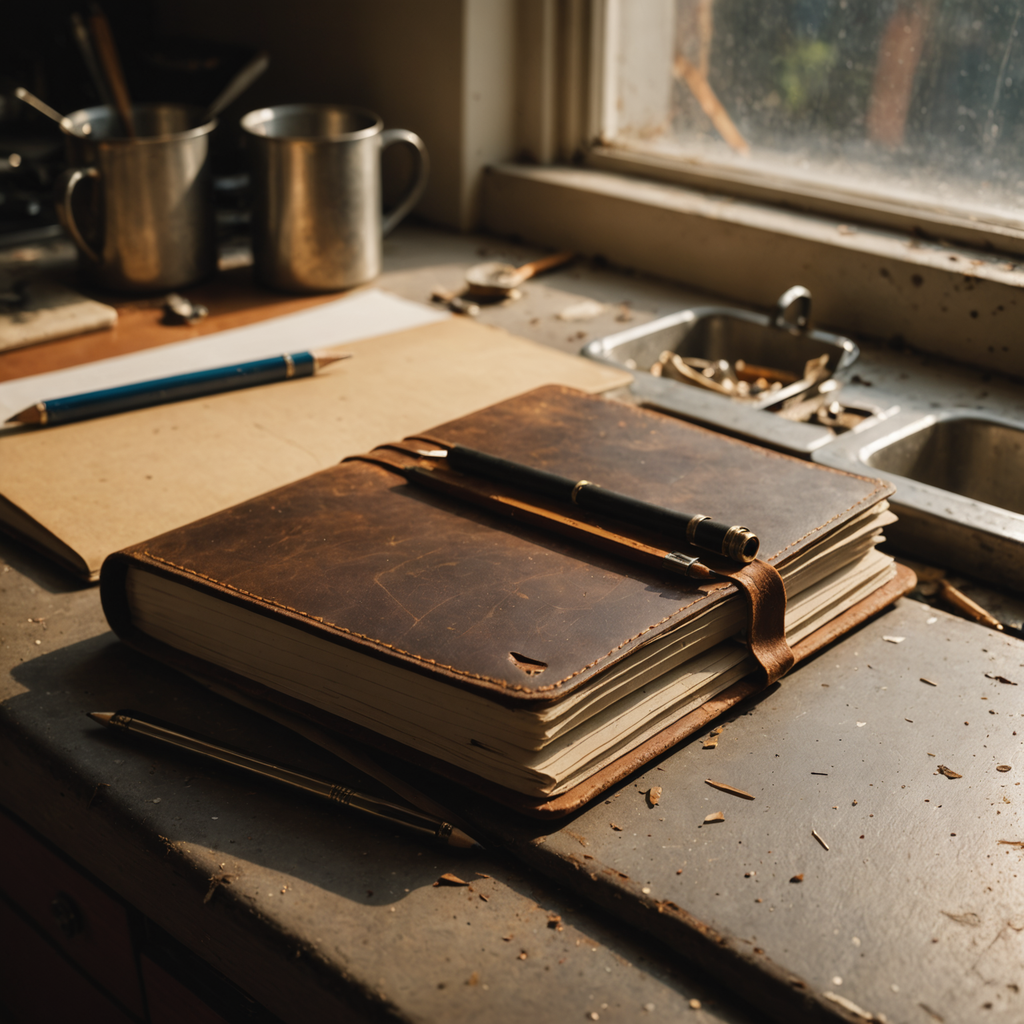
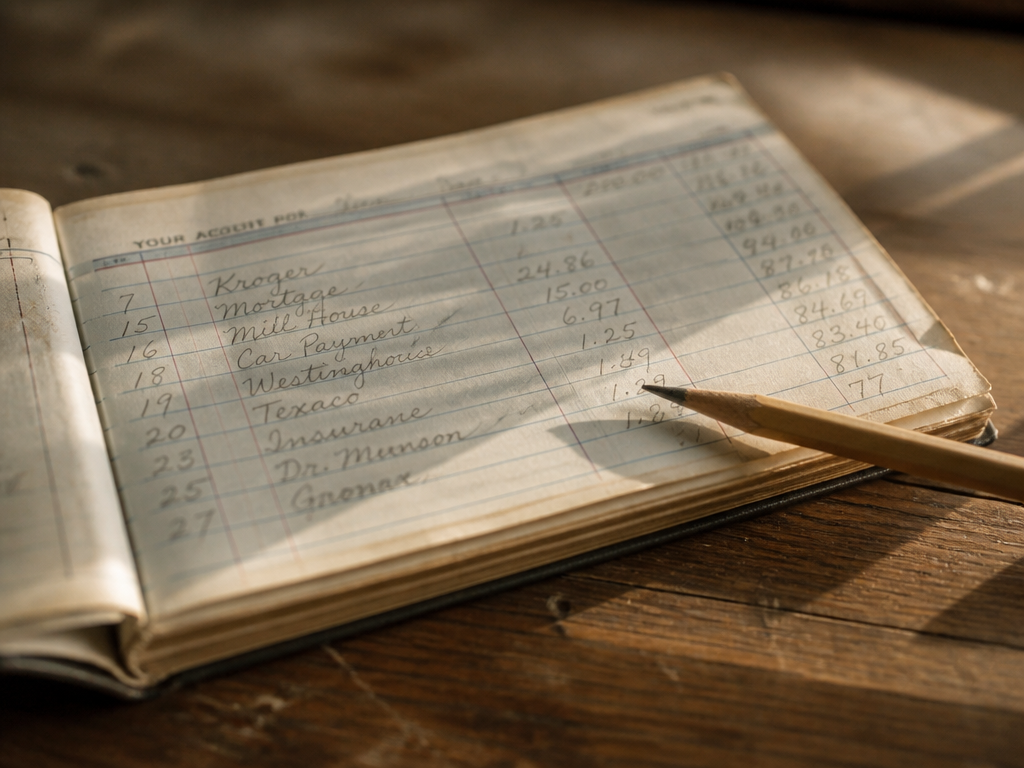
The funeral home had a plastic bin for personal effects, and the woman who handed it to me apologized for the size of it, as if a man's belongings should have needed something bigger. Watch. Wedding band, which he'd stopped wearing after my mother died but kept in his pocket like a lozenge. And a small vinyl ledger, maybe four inches by six, the kind they sold at drugstores next to the reading glasses.
I opened it in the parking lot because I couldn't make myself drive yet.
The last entry was from eleven days before. Gas, $31.14. Above it, a coffee. Above that, a birthday card for a grandson he had trouble telling apart from the other one. The handwriting had gone loose and reedy near the end, the way handwriting does, but the columns still lined up. He'd kept them straight. Whatever else was falling apart in him, the columns stayed straight.
I want to tell you I understood something in that parking lot. I didn't. I put the ledger in the glove compartment and drove to the reception and ate a ham sandwich standing up, and it was four years before I looked at it again.
There was a morning in 1968 — I was nine, and I remember it because of the smell of the Barbasol still on him — when he came home from the barber and sat at the end of the kitchen table and wrote something down before he took his coat off. I asked what he was doing. He said, without looking up, "Keeping track."
"Of what?"
"Of what it costs."
I thought he meant the haircut. I understood, in the way a nine-year-old understands things — sideways, and permanently — that a man was someone who knew the price of what he'd used up, and that the knowing was itself a kind of decency. He wasn't stingy. He gave money to the church and to his brother who never paid it back. But he could not let a dollar leave the house without shaking its hand and writing down its name.
What I took from that table was not thrift. It was this: that you were only safe if you could show your work.
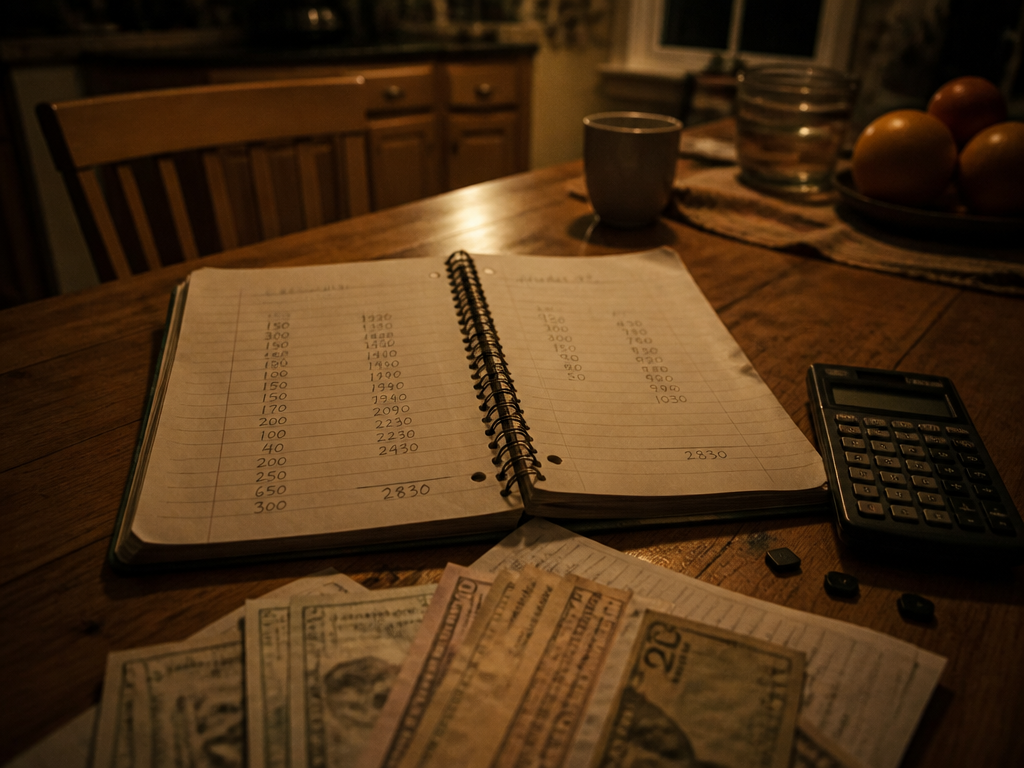
My own ledger was never on paper. That's the part that took me the longest to see, because I'd have told you, proudly, that I wasn't like him. I didn't track the groceries. I tracked something worse. I tracked what I had given and what it entitled me to, and I carried the running total everywhere, and I never once told anyone the numbers were there.
Thursday, October something, 1994. Marguerite was standing at the counter cutting the mold off a block of cheddar, which she did instead of throwing it out, which drove me crazy for reasons that had nothing to do with cheese. She said she'd been thinking about going back to school. Part-time. Just to see.
And I said — I can still hear the reasonableness in my voice, which is the worst part — "We'd have to look at the numbers."
She didn't put the knife down. She just stopped moving it. And she said, "That's not — I wasn't asking you for the money, Dennis. I was telling you a thing about me."
Then she went back to the cheese. That was the whole fight. It didn't feel like a fight. It felt like a small administrative correction, and I went and watched the second half of a game.
It took me until my fifties to understand that she'd handed me something and I'd priced it. I had a whole system for love that ran on deposits and withdrawals, and the terrible efficiency of it was that I never had to be in the room as a person. I could be a provider instead. Providers don't have to be known. They only have to produce.

My daughter Nell figured this out about me long before I did.
She swam. Not well enough for a scholarship, well enough to be at the pool at five in the morning for eight years. And after a meet in her senior year — she'd taken two seconds off her time, which I knew because I had a folded index card in my shirt pocket with all her times on it, because of course I did — she got in the car with her hair still wet and said, "You don't have to write it down."
I said something about wanting to see her improve.
She looked out the window and said, "Yeah, but like. If I got slower."
She didn't finish it. She didn't have to finish it, and she was seventeen and she didn't know how to finish it anyway. But I've thought about that unfinished sentence for thirty years. If I got slower, would you still be sitting in the stands with a pen.
I told her of course I would. And I believed it. And I also, that night, transferred the time to the master list I kept in a spiral notebook on my dresser, because believing something and being ruled by something are two different tenants in the same house.
I retired at sixty-four, which was two years later than I'd planned and about a decade after I'd stopped being any good at it.
And the thing nobody warns you about is not the boredom. It's that the accounting stops. Thirty-eight years of numbers that went up — accounts, salary, the small metal placards with my name on them that they gave out at anniversaries — and then one Friday there's a cake in a conference room and on Monday there is nothing to enter. Nothing to show. I made coffee at 6:40 in a silent kitchen and stood there with my hands on the counter and understood that I did not know what I was worth when nobody was totaling it.
That first winter I reorganized the garage twice. I alphabetized the paint cans. I am not exaggerating. I stood in an unheated garage in February putting Antique White in front of Barn Red for a house I had no plans to paint, and Marguerite came out to bring me a hat and didn't say anything about it, which was a mercy I have never properly thanked her for.
The food bank was her idea, presented as if it were mine.
I've been there four years now. Wednesdays, and Saturdays when they need it. There's a metal desk in the back with a drawer that sticks, and about a year in I found myself putting my father's ledger in it. I'd been carrying it in the car all that time. I don't know why I moved it. It felt like setting something down more than getting rid of it.
There's a woman who comes in on Wednesdays, mid-thirties, two kids, and she is careful never to take the last of anything. She'll leave one jar of peanut butter on the shelf for whoever's behind her, every single time, even when there's no one behind her. So I've gotten in the habit of putting an extra jar in her bag after she's gone past. She doesn't see me do it. There's no line for it on any form. Nobody knows about it except now you.
The first few months I did it, I noticed myself wanting to mention it to someone.
I didn't. That's all. That's the entire accomplishment, and I'm sixty-seven.
It's Wednesday. The truck came late and the cans are stacked wrong, corn mixed in with the green beans, and I'm sorting them by hand into the two bins because the labels face the wrong way when you rush it, and my knees are telling me about it, and the jar is already in my coat pocket where she won't see it.