The first thing I ever learned about grammar, I learned from the sound of it.
Mrs. Fenwick had a habit of reading our sentences aloud before she marked them. Not to shame us, she said. To let us hear. She stood at the front of the room in a cardigan the color of weak tea, holding my paragraph about a summer job at the marina, and she read: "The boats were beautiful, they rocked in the water like something asleep."
Then she stopped. She read it again, slower, putting a little hitch where the comma was.
"Do you hear that?" she said. "That's two sentences pretending to be one."
I did hear it. That was the terrible part. I heard the small collapse in the middle, the place where the sentence lost its footing, and I understood immediately and permanently that I had been caught doing something. Not something wrong, exactly. Something visible.
I was fifteen. I went home that afternoon and read everything I'd ever written in my spiral notebook, and I found forty-one of them. Forty-one places where I'd shoved two thoughts together with a comma because I couldn't bear to let the first one end.
I still do it. I've done it twice already, and I left them.
Deirdre's manuscript arrived on a Tuesday in March, four hundred and six pages, printed and shipped in a box because she didn't trust email with it. She was seventy-three. Her daughter had found my name somewhere and paid for six weeks of my time, and the note on top said, in blue ballpoint, *Please be honest. I can take it.*
People who write that can rarely take it. But they mean it when they write it, which counts for something.
The book was about her husband's illness and the four years she spent inside it with him. On page nineteen there was a sentence I've thought about since: "He asked me to bring the radio, I brought the radio."
Comma splice. Textbook. The kind of thing I'd been trained to circle before I'd finished reading it.
I put my pen down instead. I read it out loud in my kitchen with the window open, the way Mrs. Fenwick would have, and what I heard was not two sentences pretending to be one. What I heard was a woman getting up from a chair. The comma was the getting-up. A period would have put a whole night between the asking and the bringing, and there wasn't a whole night. There was barely a breath.
I wrote in the margin: *keep*.
My father wrote me exactly one letter in his life, and it was about a car.
I was nineteen, at school four hours north, and my mother had told him I was thinking of dropping out. He didn't call. He wrote a page and a half on the back of invoice paper from the shop — I could see the faint grid of it through the ink — and mailed it in a business envelope with the return address stamped in the corner like I was a supplier.
Most of it was about a '78 Impala he'd been fixing for a man in Carbondale. The transmission, the trouble with the transmission, how the man kept calling to ask if it was done. And then, in the last paragraph, without any transition at all: *Your mother says your having second thought's. Everybody has them. The car will run either way.*
Two apostrophe errors in eleven words. *Your* for *you're*. And that stray one in *thought's*, floating there like a splinter.
I want to tell you I didn't notice. I noticed instantly. I had just finished a semester of a composition course where a graduate student named Paul had covered my essays in a green pen because red was considered aggressive, and I had learned to see apostrophes the way you see a chipped tooth in someone's smile — before anything else, whether you want to or not.
I folded the letter up. I didn't write back. Not because of the apostrophes. Because I was nineteen and I thought a letter about a transmission was a letter about a transmission.
It was in a drawer in my apartment for eleven years before I understood that *the car will run either way* was the whole thing. That was him saying it. That was the most he could say.
A writer I worked with last spring — young, maybe twenty-six, very talented in the way that makes people impatient — sent me a message after I returned his chapters.
"Why do you keep flagging the semicolons," he wrote. "Is that a rule or is that you."

No question mark. He did that on purpose, I think.
I typed several answers and deleted them. The true answer was embarrassing, which is that I flag semicolons because a copy chief named Lorna told me in 2006 that a semicolon in dialogue is a lie, nobody speaks in semicolons, and I have never once questioned it in the nineteen years since. It wasn't a rule. It was Lorna. It was Lorna in a fluorescent-lit office eating almonds out of a coffee mug, saying something with total conviction on a Thursday, and I picked it up and carried it like it was carved somewhere.
I wrote back: "It's me. But I'd still cut them."
He kept two and cut nine. I think that was the correct ratio.
What I've never been able to explain to anyone is why the mistakes make me flinch. Not intellectually — I can defend the flinch intellectually all day. Clarity, precision, the reader's trust. All true, all a little beside the point.
The flinch is older than the reasons.
There was a day in 1997, my first year out of school, when I applied for a job at a small press that published field guides and regional histories. Six people applied. I made it to the last two. And the woman who called to tell me I hadn't gotten it — she was kind, she didn't have to say anything — mentioned that my cover letter had said *your* when it should have said *you're*.
"It's not why," she said. "I want to be clear it's not why. It's just — for next time."
I thanked her. I hung up. I sat on the floor of a rented room with a phone cord stretched across my lap and I felt something reorganize itself in my chest, permanently, into a shape I've been living inside ever since. Not shame exactly. Exposure. The sense that there was a version of me visible to other people that I couldn't see myself, and that it was walking around out there making impressions, and that I would spend the rest of my life trying to catch up to it.
I bought a usage guide that week. I read it the way people read scripture.
Deirdre called me in the fifth week. She'd gotten my first hundred pages back and she wanted to talk about one query.
On page sixty-two she had written about the morning her husband stopped recognizing the house. She described the light, the particular yellow of the kitchen in October, and then she'd written: "It effected him differently than I expected."
I'd changed it to *affected*. Standard. Invisible. The kind of fix I make forty times a day without registering it.
"I know which one it is," she said on the phone. Her voice had that slight formality people get when they've rehearsed. "I looked it up. I looked it up while I was writing it."
"Then—"
"I chose the other one." A pause. "I don't know how to say this so it doesn't sound foolish. Something *effected* him. Like — it did something to him. It made a different man. Affected sounds like weather."
She was wrong about the word. She was completely, unambiguously wrong, and any editor in the country would have made the same change I made.
I said, "Do you want it back?"
Another pause, longer.
"No," she said. "No, you're right. I just wanted somebody to know I didn't do it by accident."
That sentence has cost me more sleep than any rule I've ever enforced. *I didn't do it by accident.* How many times has someone said that to me, silently, in the margin of a page I was busy improving?
My mother's grocery lists were on the back of envelopes. Bank envelopes, mostly, the ones with the little cellophane windows. She'd write *potatos*. Always. Every list, for as long as I could read them, *potatos*, and one Saturday when I was maybe sixteen and had just finished a unit on plurals, I corrected it.
I took a pen out of the drawer by the phone and I added the *e* while she was in the other room getting her coat.
She came back. She picked up the envelope. She looked at it for what felt like a long time, and she didn't say anything about it at all — she said, "Do you want to come or stay," and I said stay, and she left, and I stood in the kitchen with the pen still in my hand feeling like I'd done something I couldn't undo and didn't know the name of.

She never wrote another list in front of me. I want to be careful here, because I'm not sure that's true. It's what I remember. Memory does that — it tidies the evidence into a shape that indicts you cleanly.
But I know I stopped seeing them on the counter.
There's a thing that happens in the fourth or fifth hour of editing where the words stop being words. You're just matching patterns. *Its* and *it's*, *lay* and *lie*, the dangling participle that puts a man in a raincoat inside a sentence about a filing cabinet. I can do it half-asleep. I have done it half-asleep, on a train, on the floor of an airport in Denver during a delay, at my father's kitchen table the winter after his stroke while he watched a fishing program with the sound off.
He asked me what I was doing. I said fixing mistakes.
He said, "They pay you for that?"
Not mockingly. He was genuinely trying to picture it — a job where the whole thing was finding what someone else got wrong. I could see him turning it over, this man who spent forty years standing under cars, trying to locate the dignity in it and not quite getting there.
"It's more like — making it sound like what they meant," I said.
He nodded. He went back to the fishing. Ten minutes later he said, to the television, "Well. Somebody's got to."
I've decided that was approval. It might not have been.
The writer with the semicolons sent me his finished book in the fall. There's a page near the end where the narrator's brother says something and the punctuation is wrong — deliberately wrong, a run-on that spills for six lines without a single stop — and it's the best thing in the book. It's the only place the brother sounds like a person losing his grip on a story he's telling.
I'd have flagged it in draft. I'm sure I did flag it. He kept it anyway, and he was right, and the fact that I know he was right doesn't stop me from wanting to fix it every time I open to that page.
That's the part nobody warns you about. You don't graduate out of the flinch. You just develop a second thing that runs alongside it, a slower voice that says *wait*, and the two of them argue, and mostly the slow one wins now, but never quietly. Never without cost.
I got the boxed manuscript back from Deirdre's daughter in June with a note. Deirdre had died in May. The book was going to a small publisher anyway; the daughter wanted to know if I'd look at the last section, which her mother hadn't finished cleaning up.
I said yes, obviously. I said yes before I'd finished reading the email.
The last chapter is thirty pages and it's a mess. Tense shifts. A paragraph that starts in 1974 and ends in a hospital corridor in 2019 with no signal that time has moved. Apostrophes in plurals — *the nurse's were kind* — the same splinter my father put in *thought's*, forty years and eight hundred miles apart, two people who never met, both reaching for the same wrong mark for the same reason, which is that when you're saying something that costs you, your hand does things your eye doesn't catch.
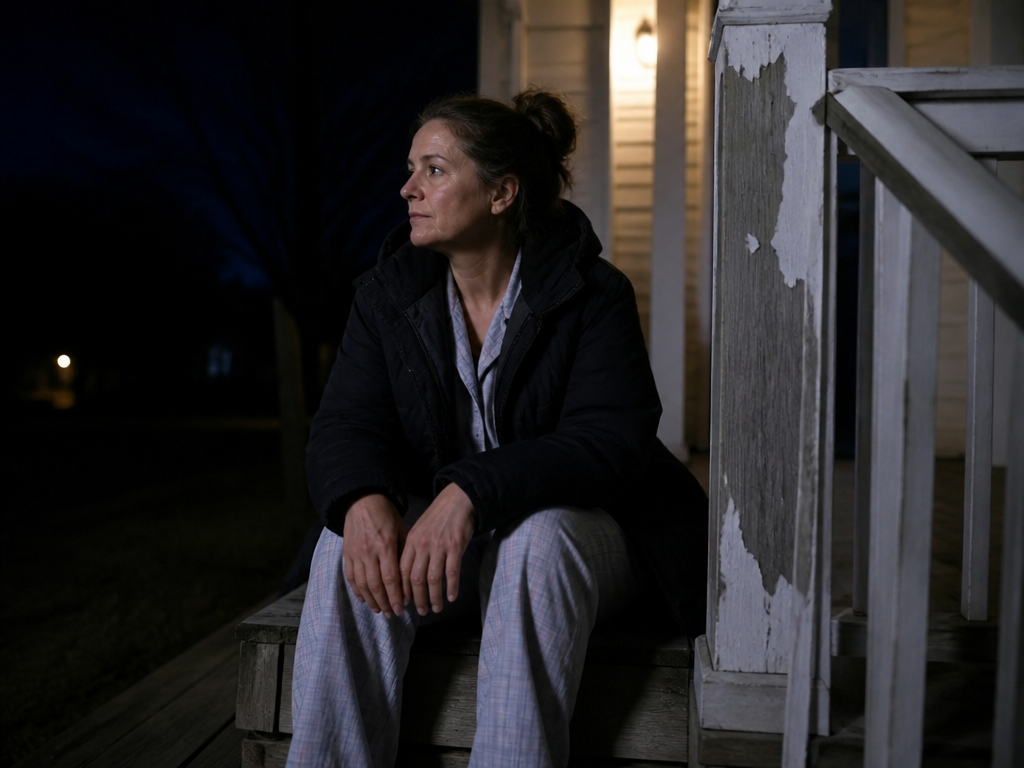
I'm at my kitchen table with it now. It's past eleven. The window's open again because it's July and the house holds heat.
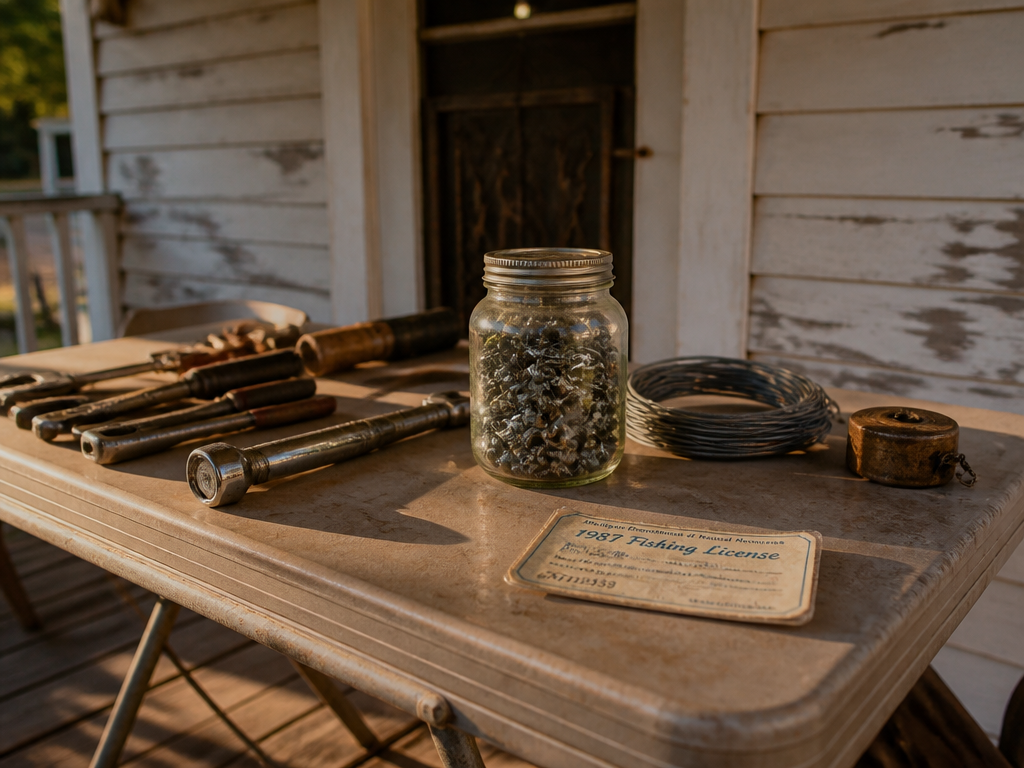
On page three hundred ninety-one she wrote: "I don't know what to do with his tools, there so heavy."
*There* for *they're*. And a comma splice on top of it, the same one Mrs. Fenwick caught in me when I was fifteen with my paragraph about the boats.
I fixed the *there*. That one I fixed, because she'd have wanted it and because some things are just the hand slipping.
Then I sat with the comma for a while. I typed a query: *Consider period or semicolon here — two independent clauses.* I read it back. I read the sentence back, out loud, in the kitchen, the way I've done since I was fifteen.
And there it was. The getting-up. A woman standing in a garage looking at a wall of wrenches she has no use for and no way to lift, and the comma is the whole weight of them.
I delete the query. I close the file. I get up and pull the window down against the noise, and the sash sticks the way it always does, and I hit it once with the flat of my hand.