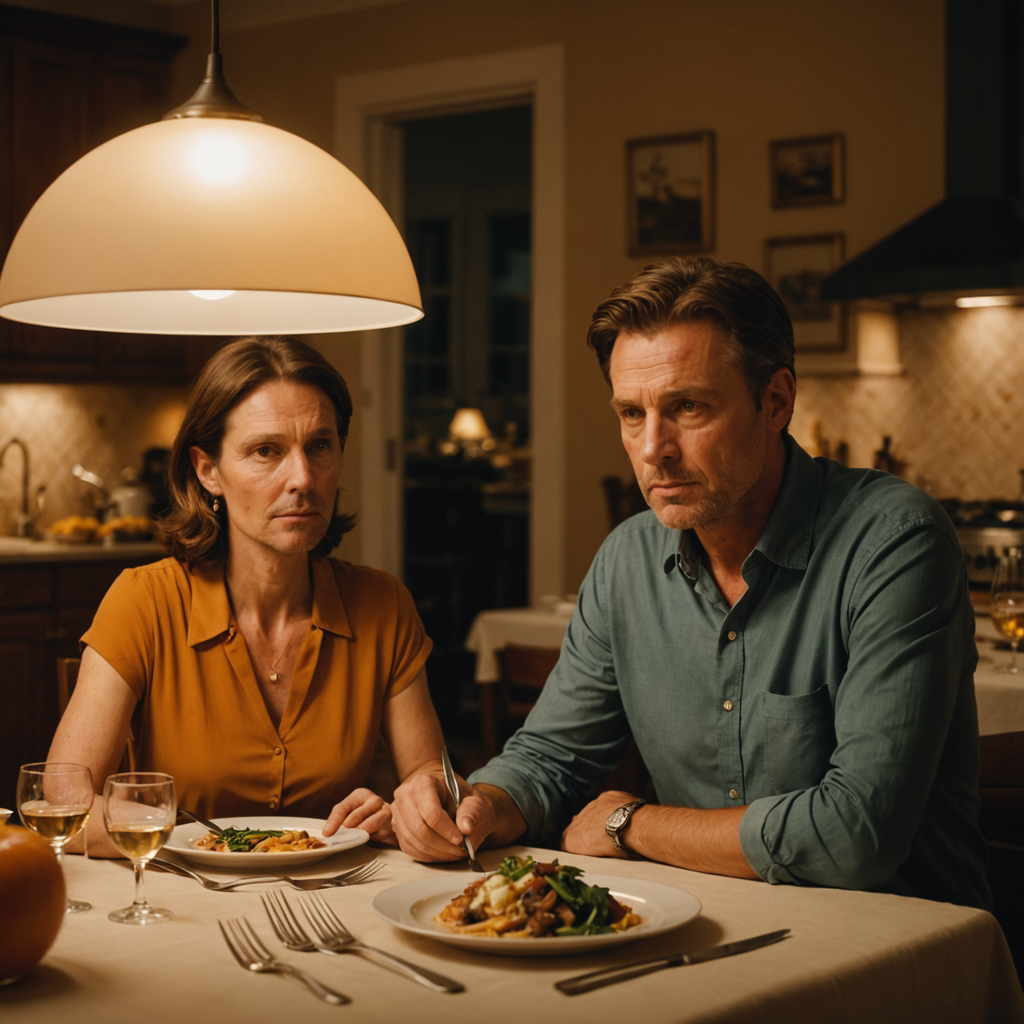
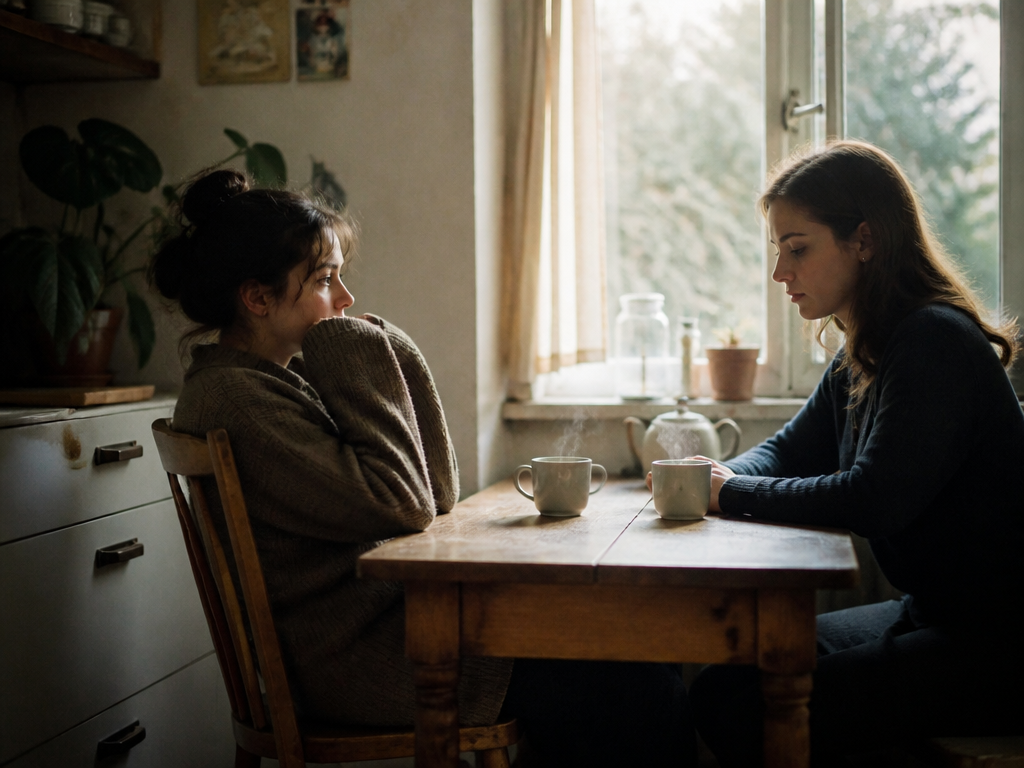
My husband does this thing where, when I'm upset and trying to talk while also doing five other things, he stops doing whatever he's doing. Just stops. The other night I was unloading the dishwasher and complaining about my sister, and halfway through a sentence I noticed he had put down the knife he was using to cut a lime and was looking at me. Not nodding along. Not waiting for his turn. Looking.
For years I thought this was nothing. A personality quirk. The way some people are good at parallel parking. It took me an embarrassingly long time to understand that it was the whole thing — that the entire architecture of feeling safe with someone was built out of small gestures like a man setting down a paring knife because his wife's voice had changed pitch.
I keep trying to make a list of what these gestures are. I keep failing, because the moment I name one it sounds smaller than it is.
There was a man I dated in my late twenties who could win any argument. I mean any. He had a lawyer's mind and a wounded boy's heart, and he used the first to protect the second. We once fought for three hours about whether I had said I'd meet him at seven or seven-thirty. I remember sitting on the floor of his apartment near the radiator, which ticked and hissed, and at some point realizing that being right had become the only thing either of us wanted. He won. He produced a text message. He held the phone up like evidence. And I felt something close in me like a shop pulling down its shutter at the end of the day.
What I understand now, that I couldn't have said then, is that he never once asked why I was so upset about being late. He only wanted to establish that I had no right to be. The facts were a fortress, and I was outside of it.
My husband loses arguments on purpose sometimes. Not in a martyred way. He'll just say, "Yeah, you're probably right," when I can tell he doesn't fully think I am, because he has decided the disagreement isn't worth what it would cost. It used to drive me crazy. I wanted to fight all the way to the bottom. I thought that was honesty. Now I think it was something else, something I'd inherited and called by the wrong name.
The radiator man would have called this weakness. For a while, so would I.
My mother used to apologize in a particular way that wasn't really an apology. She'd say, "I'm sorry you feel that way." I can still hear it — the slight upward lift on "feel," as if my feeling were a curious local weather system she bore no responsibility for. I learned to do this too. I was good at it. I could say sorry in a way that handed the whole problem back to the other person, gift-wrapped.
The first time my husband apologized to me, really apologized, I didn't recognize it. We'd had some stupid fight before a dinner party and arrived furious, performing happiness for our friends, driving home in silence. In the dark of the car he said, "I was a jerk about the parking thing. I get weird when we're late and I took it out on you. I'm sorry." That was it. No "but." No accounting of my own crimes. I sat there waiting for the second half, the part where it became my fault again, and it didn't come. I almost didn't know what to do with my hands.
I think I cried a little, which confused him.
There's a couple we know, married longer than us, and the wife does something I've come to find unbearable, though I love her. Whenever her husband starts to express any negative feeling — tired, worried, disappointed — she rushes in to fix it. "Oh, don't say that, you're going to be fine, that's not true, you always say that." She means it as kindness. I've watched his face while she does it. I've watched him decide, in real time, not to bother. He shrinks the feeling down to a size that will fit through the small door she's left open, and then he stops talking.

I mention this because I used to do it and didn't know. When my husband would tell me he was anxious about money, I'd immediately reassure him, recite our savings, build him a little spreadsheet of comfort. I thought I was helping. One evening — we were walking the dog, it was that blue hour in October when the streetlights aren't quite on yet — he stopped and said, "I don't need you to fix it. I just wanted you to know it's in me."
It's in me. I've thought about that phrase for years.
Now when he tells me something heavy I try to do nothing first. Just receive it. It is the hardest thing I have ever practiced, harder than running, harder than holding my tongue. My whole body wants to leap into management. But I've noticed that when I manage to do nothing, he tells me more. The thing under the thing comes out. The money worry turns out to be about his father, who died believing he'd failed, and the spreadsheet I used to build was, I see now, a way of refusing to hear that.
My father gave me a watch when I turned thirty. It was his father's. He handed it to me across a restaurant table without ceremony, sort of pushed it at me, and said, "This is — anyway, you should have it." That was the whole speech. My father is not a man of speeches. But I noticed his hand was not quite steady, and I understood that the gift was enormous, and that the smallness of the words was not the size of the feeling. They never are, with him.
I think emotional intelligence might partly be this: knowing that the words are not the size of the feeling. Learning to read the hand and not just the speech.
The radiator man read only the speech. He took everything at face value and then litigated the face.
My husband notices when I haven't eaten. This sounds like nothing again. But there is a specific way I get — short, brittle, sure that everyone is mildly against me — and he learned the signs before I did. He'll just put a plate of something in front of me, no comment, and twenty minutes later I'm a person again. The first few times he did this I was insulted. I thought he was dismissing my real and valid feelings as mere blood sugar. Sometimes he was. Sometimes my feelings were also real. Both can be true, which is a sentence I would have found infuriating at twenty-five.
There was a night early in our marriage when I said something cruel. I won't repeat it; I'm still ashamed. I said it to win, the way I'd been taught, going for the soft place because I knew where it was. And he didn't fire back. He got very quiet and went into the other room, and I sat on the bed feeling triumphant for about ninety seconds before the triumph curdled into something awful.
When I went in to find him he was sitting on the edge of the tub, not crying, just sitting, holding his own elbows. He said, "I think you wanted to hurt me, and it worked, and I don't know what to do with that." He wasn't accusing me. He was reporting from inside the wound. And I realized that the radiator man and I had spent years teaching each other to weaponize honesty, and here was a person who could be hurt and tell me so without making me pay for it.
That's the part I find almost impossible to describe. He let me see what I'd done without forcing me to drown in it. He left me room to come back. The cruelest people I've known were not the ones who hurt me but the ones who, when I hurt them, made sure I could never repair it.

My grandmother was married to my grandfather for fifty-one years and I never once heard her thank him for anything. They had a good marriage, I think, by the measures of their time. But there was a flatness to it, a sense of two people who had stopped seeing each other because the seeing had been used up somewhere around year fifteen.
My husband thanks me for things that are objectively my job, our shared job, nobody's job. "Thanks for getting the kids' shoes." "Thanks for remembering my mom's birthday." It seemed excessive to me at first, almost transactional, like he was keeping a ledger. It took me a while to feel the difference. A ledger is about debt. This is about noticing. He is, I finally understood, in the habit of seeing me, and the thank-yous are just the noise the seeing makes when it leaks out.
I am worse at this than he is. I notice his work and forget to say so. I'll think, all day, about how lucky I am, and then say nothing, as though the thinking counted. It doesn't count. My grandmother probably thought a great many tender things she never said, and my grandfather died not knowing them, and that is its own kind of tragedy, the love that stayed locked in the chest of the person feeling it.
Once, we were lying in bed and I asked him something I'd never asked anyone. I asked what he was afraid of. Not in general. Right then, that month, in his actual life. He was quiet for a long time. The ceiling fan turned. And then he told me, and it was not what I expected, and I had to revise my whole sense of the man lying next to me. I had assumed I knew the shape of his fears. I'd been carrying around a version of him that was several years out of date.
I think we do this constantly. We marry a person and then keep being married to the idea of them, the file we made early on, never updating it. The asking — the real asking, the kind where you might be surprised by the answer — is how you stay married to the actual person and not the photograph.
I don't ask enough. I'm telling you all of this as though I've learned it, but mostly I've just watched someone else do it and felt the relief of being on the receiving end.
The lime, on the counter, half-cut. He'd set down the knife and was looking at me, and I lost the thread of what I was saying about my sister because I'd been distracted by my own awareness of being listened to, which is a strange and rare feeling, like stepping out of a noisy room into a quiet one and hearing how loud the noise had been.
I keep wanting to tell people that this is what to look for. Not the grand gestures. The knife set down. The apology without the second half. The plate of food. The thank-you for the shoes. The question you didn't see coming. I want to make it into something teachable, a list I could hand to my younger self in that apartment near the radiator, who thought love was a thing you won.
But here is what I haven't been able to shake, now that I've written all this down. I don't actually know if any of it is true. I've made my husband sound like a wise man and myself like a reformed combatant, and I've made the radiator man into a villain, and life is not so cleanly cast. Maybe my husband sets down the knife because he's tired and grateful for the interruption. Maybe I've turned ordinary marriage into a parable because it's easier than admitting I still, some nights, go for the soft place and hit it dead on. I wrote a whole essay about being seen. I'm not sure I've ever once asked him whether he feels I see him at all.