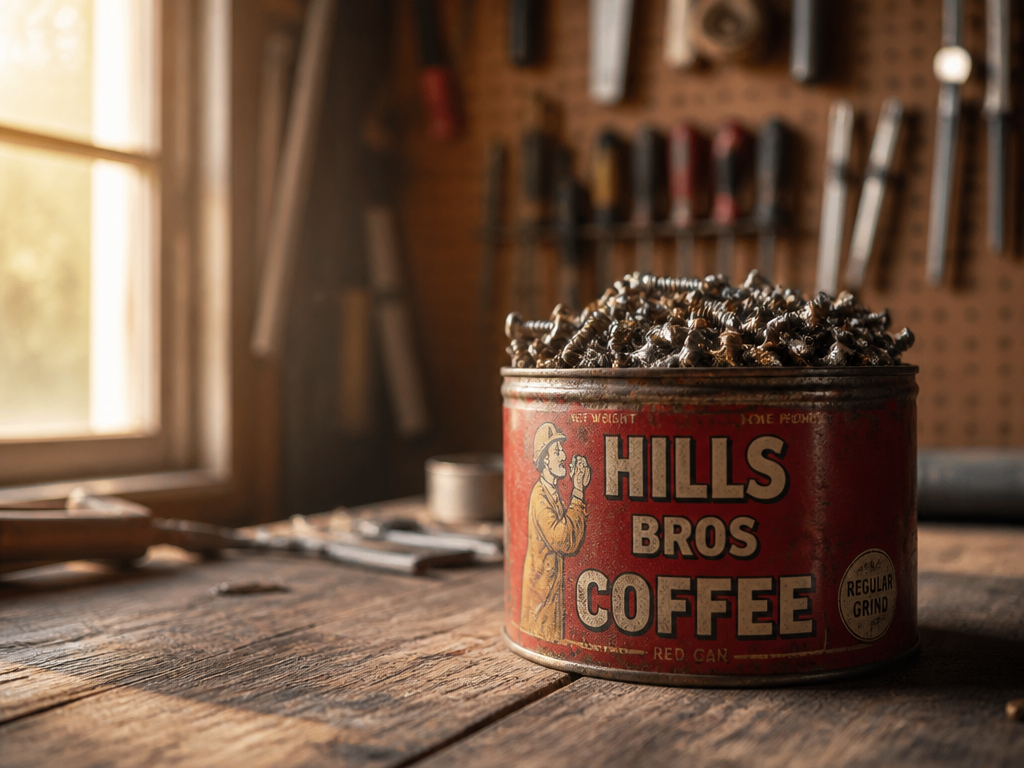
Don was holding a coffee can full of screws, and he would not put it down.
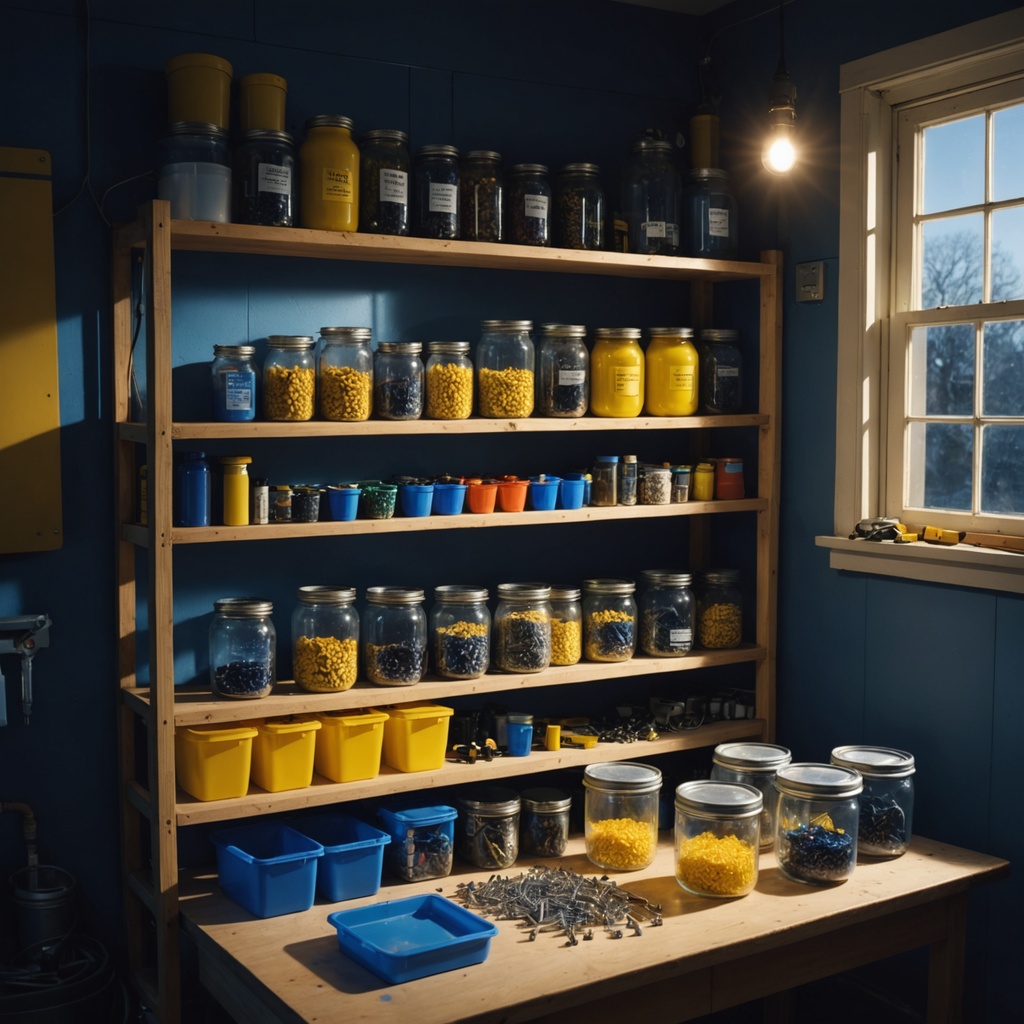
It was the third time that week he'd pulled everything off the pegboard. I'd come over to drop off a ladder, and there he was at seven-thirty in the morning, surrounded by labeled containers, a label maker dangling from his wrist by its little plastic loop. The screws went in one can, then he frowned, dumped them onto the workbench, and started separating them by length. Phillips here. Flathead there. The hum of the garage fridge. The smell of WD-40 and sawdust from a project I never saw finished.
"You alright?" I asked.
"These were a mess," he said, not looking up. "Whole system was wrong."
The system had been fine. I'd borrowed tools from that garage for eight years. You could find anything in it blindfolded. But Don kept rebuilding it like a man trying to remember something he'd written on his hand before it washed off.
What I didn't know to call it then was grief. He'd retired six weeks earlier from running operations at a regional trucking outfit. Forty-one years. They gave him a watch he never wore and a steak dinner where his old crew told stories that made him laugh so hard he had to take his glasses off to wipe his eyes. And then he came home, and the next Monday there was nothing. No phone ringing at 6 a.m. about a driver stuck in Tucson. No one needing him to solve anything.
So he solved the screws.
My wife thought he was being difficult. "He snapped at Mom over the dishwasher," she told me, scandalized, because Don did not snap. Don was the calmest man at any table. "He said she was loading it wrong. She's loaded it the same way for thirty years."
I nodded along. I agreed he was being strange. I had no idea I was about three years from becoming exactly the same kind of strange myself.
When people warn you about retirement, they warn you about the wrong thing. They talk about money, which matters, and they talk about boredom, as if the problem is too many empty hours, a Tuesday that won't fill itself. Everyone hands you the same advice. Get a hobby. Take a class. Volunteer. As though the issue were a calendar with too much white space on it, and the solution were ink.
But Don's calendar was full. He'd taken up woodworking. He walked the dog twice a day, a route so precise the neighbors set their watches by him. He had things to do. That wasn't it.
The thing nobody tells you is that you don't just lose your job. You lose the thing the job was holding up. For most of us, work isn't only what we do. It's the scaffolding we built our whole sense of mattering on, beam by beam, decade by decade, until we forgot it was scaffolding at all and started mistaking it for the building.
I learned this the embarrassing way.
I left my own career at fifty-eight, a long stretch of work I won't bore you with except to say it had a title that made strangers nod respectfully at dinner parties. I'd told myself for years I couldn't wait to be done. And then I was done, and the first thing I did, three days into freedom, was order business cards.
I want you to understand the full stupidity of this. I had no business. There was no company. I sat at my kitchen table with my laptop open to one of those print-your-own-cards websites and I typed my name and then I sat there with the cursor blinking in the box where the job title goes, and I could not make myself leave it empty. A name with no title under it looked like a tombstone with the dates missing. So I invented something. "Consultant," I typed, which meant nothing, which I knew meant nothing even as I clicked order. Two hundred of them. Glossy finish.

They arrived in a little box four days later and I never gave out a single one. I found them eighteen months on, in a drawer, and I felt the way you feel when you find a love letter you wrote to someone who never wrote back. Foolish and tender toward the version of you who needed something that badly.
Because here is what the cards were. They were me trying to answer the question that had been asked of me at every gathering for forty years and that I suddenly couldn't answer. *So what do you do?* I'd been asked it ten thousand times and never once felt it as a threat. Now it felt like being asked who I was, and discovering, in front of a stranger holding a paper plate of crudités, that I didn't know.
I'd been a verb my whole life. Now I was a noun, and the noun was just my name, and my name didn't seem like enough.
There's a particular cruelty in how this gets misread by the people who love us. They see the snapping at the dishwasher. The garage reorganized three times. The man who used to manage forty drivers now standing in the cereal aisle for ten minutes because he cannot, for reasons that would sound insane if he said them aloud, decide between two brands of bran flakes — not because he cares about bran flakes but because deciding feels good, deciding is the last muscle that still works, and so he flexes it on whatever's in front of him.
The family calls this getting difficult. Getting set in his ways. Old man stuff. And maybe it looks like that from the outside. But from the inside it's something closer to a man patting his pockets over and over for keys that aren't there.
I think about my mother, who taught fourth grade for twenty-nine years in the same brick school. The September after she retired, she drove me past it. We weren't going anywhere near it — she made a turn that added fifteen minutes — and she slowed down in front of the building and didn't say anything, and I watched her watch the kids lining up at the door, and a young woman I didn't recognize was out there with a clipboard, herding them, doing the thing my mother had done with her body in that exact spot for three decades.
"They moved my room," my mother said. That was all. "That used to be my room, the windows on the end. They've got the computers in there now."
She pulled away before the light changed. I was twenty-six and didn't understand. I thought she was nostalgic for a classroom. I know now she was looking at the place where she'd been real, where two thousand children over twenty-nine years had needed her to be the most important adult in the building, and she was watching that role continue without her in it, like attending your own replacement's first day. She got chatty and impatient and oddly competitive about small things for about a year after that. We said she'd gotten *prickly.* What she'd gotten was unhired from the only role that ever told her she counted.
The people who handle retirement worst, I've come to think, aren't the ones who loved their work the most. I used to assume that — that the devastated ones were the workaholics getting their comeuppance, finally forced to feel the family they'd ignored. But it's not that clean. Some people who loved their work had other rooms in the house of themselves. They were also the guy who fixes everyone's mowers, or the woman who runs the church rummage sale, or somebody's grandfather who tells the same fishing story with the patience of a man who has decided that telling it is itself the point. They had more than one place to stand. When one floor gave way, they didn't fall all the way down.

It's the people who built everything on the single beam. Who were *only* the title. They're the ones standing in the rubble afterward, holding a coffee can of screws, sorting them by length because sorting is the last thing that feels like competence.
I did not, I want to be honest, handle it gracefully. I picked fights about the thermostat. I developed strong opinions about how the lawn should be mowed, opinions I had never held in my life, opinions that arrived fully formed the same month I had no one left to manage. My wife, who is kinder than I deserve, said one night over dinner, "You're managing me. You know that, right? You're running me like a department."
I started to deny it and then I heard the words I'd said to her that morning, about a more efficient way to do the grocery list, and I shut my mouth. I had become, in retirement, a middle manager of a company with one employee who hadn't agreed to be hired.
That was the night it cracked open a little for me, though it took longer to do anything with it. The cruel joke of it was that all the energy I used to spend mattering at work hadn't gone anywhere. It was still in me, the same wattage, and with the job gone it had nowhere to flow, so it backed up and flooded the smallest channels available. The screws. The dishwasher. The thermostat. The bran flakes. We were all, every retiree I'd ever quietly judged, just trying to feel useful in whatever room still had a door we could open.
Months later — past a year, into the part where I'd started to be a person again, though I couldn't tell you exactly what I'd done to get there except that I'd stopped pretending I was fine — I was back in Don's garage. We were both retired now, two men with nowhere to be, which gave our visits a strange, unhurried quality, like teenagers killing a summer.
The garage was, I noticed, immaculate. Beyond immaculate. The screws were in clear divided trays now, the kind with the little snap lids, each compartment labeled in his neat capitals. Every tool hung on a pegboard outline he'd traced in marker so you'd know where it went back.
"Looks good in here," I said.
Don stood there a second. He had a rag in his hand he wasn't using.
"You know what's funny," he said. "I had this thing perfect about a year ago. Then I tore it all apart again. Couldn't tell you why." He laughed, but it wasn't really a laugh. "Marge thought I'd lost my mind."
"Did you ever finish that bookshelf?" I asked. The project from the early days, the wood I'd smelled that first morning.
He looked toward the corner, where a half-assembled frame leaned against the wall, exactly as unfinished as the day he started it. The clamps were still on. They'd been on for two years.
"Going to," he said. "One of these days."
We stood there. Outside, a mower somewhere a few houses down. The garage fridge hummed its same hum.
"I keep the radio on out here," Don said suddenly. "All day. Even when I'm not doing anything. Just so there's a voice." He stopped, like he'd surprised himself by saying it, and then he picked up the coffee can — there was still a coffee can, an old one, holding nothing now — and he turned it over in his hands.
"You want a beer?" he said. "It's almost eleven."
I said sure. He set the can down on the workbench, in the spot where it lived, the one place in the whole spotless garage that didn't have an outline drawn around it. Then he reached for the fridge and stood there with the door open, the cold air pouring out around his legs, looking in at the two bottles and the half-empty jar of pickles like he was waiting for one of them to tell him what to do next.