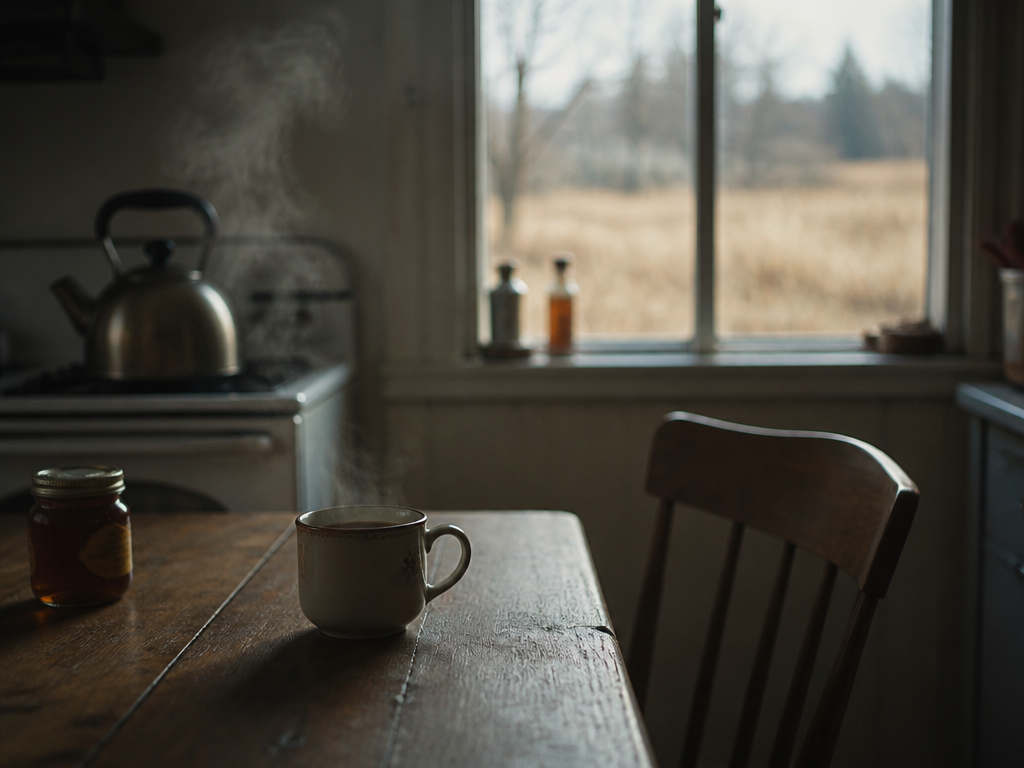
Tuesday morning, the radiator ticking like something keeping count. Nate at the far end of the table with the seed catalog he has already been through twice, one finger holding his place under a line about heirloom tomatoes. I came down at ten past seven. It's nearly eight now and neither of us has said a word, and a minute ago, without lifting his eyes off the page, he slid the sugar bowl four inches to his left, into my reach.
That's the whole event. I have tried to describe it to people and it comes out sounding like a marriage that ran out of things to say.
October of 1987, driving home from the Kellermans' twenty-fifth anniversary party. My mother took off her clip-on earrings at the light on Ashwood and held them in her fist the rest of the way. "Well," she said. "That was nice." Half a mile later: "That was really nice, wasn't it, Dale." He said it was. She said it again in the driveway with the engine off, and again going up the stairs, and I was thirteen in the back seat thinking she was trying to convince somebody and not being certain who. I never once rode in a car with my parents in which nobody was talking.
Erie, 1996, three hours each way for his sister's wedding. I kept a list — not written down, a running inventory in my head that I'd add to during the week, things to bring up if the car went quiet. His coworker with the boat. Whether we should get a dog. At mile forty he said, "You're quiet." Not a question. He said it the way you'd tell someone they left a burner on. I went to the list.
We were quiet for six weeks in the winter of 2016 over what to do about his mother's house. That quiet was a different animal entirely. In the hallway outside the bathroom we both turned sideways so our sleeves wouldn't touch, and I remember being able to hear the refrigerator from the far end of the house, which I had never heard before and have not heard since. Each of us carrying a sentence we had decided not to spend.
My niece's wedding, the maid of honor with index cards trembling slightly in both hands: "Promise me you guys will never stop talking to each other. Like — actually talking." Everyone raised their glasses. I raised mine. I was thinking about earrings in a fist.
Ruth, at her kitchen counter, eight months after Gerald. I asked how she was doing with the evenings and she said, "It's not the — we weren't big talkers, honestly. We watched a lot of television." She turned her cup a quarter of the way around on the saucer. "He'd come up at eleven and his belt would hit the floorboards and I'd know what time it was without looking at anything." Then she asked whether I wanted the rest of the coffee cake to take home, because it was only going to go stale on her.
Twenty-three years in, I can tell his quiets apart, mostly. There's the one that's arithmetic — the roof, the property taxes — and it lives in his jaw, a kind of set to it. There's the one where a song is running in there somewhere and his thumb goes against his knee in a pattern he doesn't know he's making. I'm right maybe seven times out of ten. Which is a decent average, and also, on certain nights, nowhere near good enough.

Last April I asked him four times in one evening what was wrong. By the fourth he put the remote down on the arm of the chair. "There wasn't anything. There might be now." Then, quieter, not looking at me: "I was just tired, Marne." I had spent three hours reading a blank page as if it had my name written on it.
Eleven days between the callback and the results. In the waiting area at the imaging center he took my foot into his lap, the one in the sock, because I'd kicked my shoe off without noticing, and he kept his eyes on the television bolted up near the ceiling where a man was explaining a cold front. He didn't tell me it would be fine. He had told me things would be fine before, about smaller matters, and we both understood that particular currency was no good here. He held my foot for forty minutes. I have never in my life been spoken to more clearly.
A woman at a party asked me once what we still talk about, after all this time, and there was a thin layer of pity in it that I don't think she knew was there. I said we mostly talk about the dog. That was true, and it was also a lie, and I didn't have the twenty minutes it would have taken to say the other thing.
I don't want to make quiet into a virtue. There are houses where nobody speaks because speaking costs more than anyone can pay. I grew up two doors down from one of those, the Vances, and you could feel it come off their porch like cold off a window in January. The difference isn't in the sound. It's in what's underneath — whether the not-talking is a held breath or the ordinary breathing of two people who have already been through the part where you explain yourself.
The not-talking took years to build and I couldn't tell you which years. Somewhere in there we stopped narrating our own marriage to each other. Somewhere in there he learned that when I stand at the sink too long after dinner, I'm working something out and would rather not be interrupted, and I learned that when he goes out to the garage with no project in mind, he'll come back in a better mood if nobody asks about it. Nobody taught us. Nobody could have.
What I've never known how to say is that it isn't emptiness. The quiet has weight, the way a wool coat has weight, and I noticed the weight of it about six years ago and have been paying attention ever since, the way you'd pay attention to a sound in the walls, except it's the opposite of that.
This morning I came down at ten past seven. The catalog on the table is a new one, this year's, the same tomatoes on the cover, and the sugar bowl was already at my place before I got there. Through the window over the sink I could see him out at the beds in his coat, holding one end of the tape measure down with his boot.