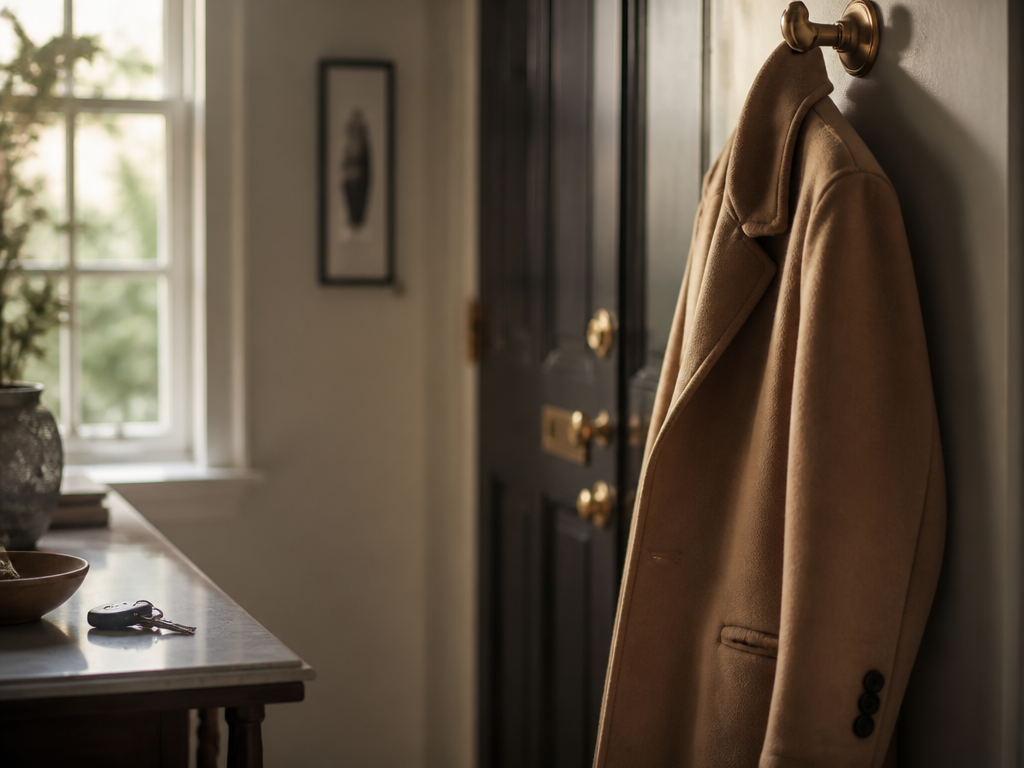
I figured it out too late to feel clever about it. The thing people praised in me for forty years — that I was steady, that you always knew what you'd get — was also the reason my daughter stopped telling me things.
She didn't say it like that. Nobody hands you the diagnosis clean. What she said, at a restaurant two winters ago, was that talking to me felt like reading a thermostat. She laughed when she said it, pushing a piece of bread around her plate, not looking up. "You're just so… level, Dad. Every time. It's like nothing gets in." Then she changed the subject to her job, and I sat there holding my water glass, understanding that a compliment I'd worn my whole life had just been returned to me as something else.
I want to go back to where it started, because I don't think I invented it. I think I inherited it.
My father kept the same Saturday for as long as I knew him. Up at six, the transistor radio on the windowsill tuned to the farm report he didn't need, coffee measured with the same dented scoop, the lawn done by nine whether it had rained or not. Once, I must have been eleven, a storm knocked our maple across the driveway and he still went out at nine with the mower, working around the fallen tree like it was a piece of furniture someone had left in the wrong spot. My mother watched from the kitchen window and said, quietly, to no one, "God forbid the grass waits a day." I remember thinking he was strong. It took me most of my life to hear the other thing in her voice.
What I learned from him wasn't discipline exactly. It was that if you never varied, you never had to explain yourself. Consistency is a wall you can hide the whole house behind.
So I built my wall. I was the friend who answered every call, the one who remembered the anniversaries of other people's losses, who showed up with the folding chairs before anyone asked. And people loved me for it, or said they did, and I mistook being counted on for being known.
There was a man named Errol I worked beside for nineteen years. We ate lunch together most days, same corner table, and I could have told you his order in my sleep. When he retired he took me aside and I braced for the warm thing, the you're-the-best-of-them speech. Instead he shook my hand and held it a beat and said, "You know, I never once saw you have a bad day. I used to wonder what you did with them." Then he picked up his box of desk things and left, and I stood in the hallway realizing I had known this man for nineteen years and he had just admitted he'd never met me. He'd met the performance. The reliable man. The one who was never off duty.
Because that's the part nobody warns you about. Being the same in every room sounds like integrity, and sometimes it is. But sometimes it's just fear wearing a nice coat. If you're identical everywhere, no one ever gets the private version — the one who's frightened, or petty, or wildly happy for no reason. You've made yourself trustworthy by making yourself unavailable. People can predict you precisely because there's nothing underneath the prediction they're allowed to reach.
My wife knew, of course. Wives always know first and say last. Years ago she asked me why I never told her when work went badly, and I said something about not wanting to bring it home, and she looked at me for a long time and said, "I didn't marry a weather system, Harold. I'd take a storm over this." I thought she was being dramatic. I told myself I was protecting her. What I was protecting was the wall, and the small terror of being seen mid-collapse, which I had decided at some point was the worst thing a person could be.
Here's the strange arithmetic of it. I spent my life being dependable so people would stay close, and the dependability is exactly what kept them at arm's length. You cannot get near a man who is always fine. There's no door in a smooth surface.
I think about my father on that stormy Saturday more than I'd like to admit. I used to see a man who couldn't let the grass wait. Now I see a man who didn't know how to be a person who lets the grass wait — who had made his whole self out of a routine because the routine could not disappoint anyone, could not be caught off guard, could not be asked for more than it had already decided to give. He died the way he lived, on schedule, and I gave a eulogy about his steadiness that everyone nodded at, and not one of us in that church could have told you what he was afraid of.
I don't have a clean ending for this. I'm sixty-eight and I've spent maybe three years now trying to be a little less legible, and mostly I fail, because forty years of practice doesn't loosen because you finally understood it. Last month my daughter called on a Tuesday, which is not a day we talk, and I could hear something wrong in her voice before she said a word. And instead of steadying her, instead of being the thermostat, I told her the truth — that I'd had a frightening morning, that a test result had come back and I was scared, that I didn't want to be brave about it on the phone.
There was a long quiet on the line. Then she said, "Okay. Okay. Tell me what the doctor actually said," and her voice had changed completely, and she stayed on the phone with me for an hour and a half, and at the end of it, right before she hung up, she said something I keep turning over.
"You sound like someone I could actually worry about. It's kind of nice."