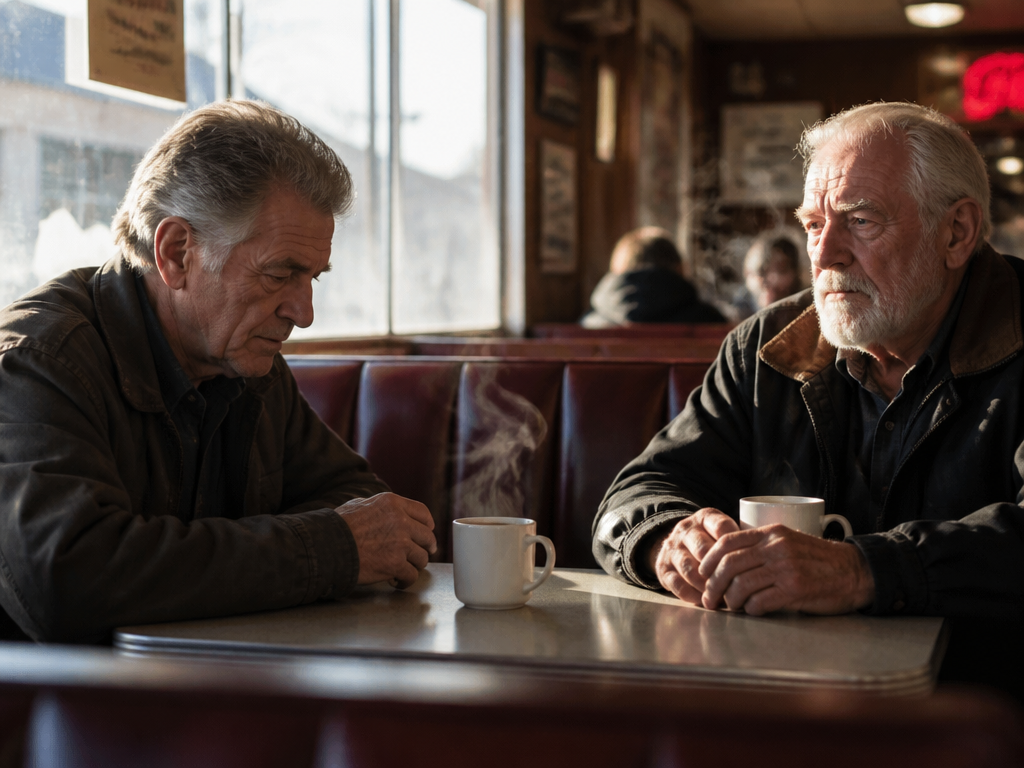
The two men at the counter didn't know each other at seven-forty. I'm sure of it, because I was there from the start, holding a sugar packet I didn't need, waiting on a refill that never came.
One was around eighty, windbreaker zipped to the chin though the place was warm enough to fog the front glass. The other was maybe sixty-five, work boots, phone face-down beside his plate. They'd been doing the ordinary thing — weather, the lane closure on the bridge — until the older one mentioned he'd carried mail for thirty-one years.
The younger man put his fork down.
"Out of Elm Street?"
"Out of Elm till they shut it. Then the new one. Never did like the new one."
"I had 12 and 14. Nine sometimes, if somebody called out."
What happened after that wasn't a conversation about the postal service. It was dogs. Not dogs in general — particular dogs, dead thirty years, each one with an address attached to it. The German shepherd at 44 Ridgeway that came around the side of the house without making any sound at all. The small one on Foster that was worse than the shepherd. A porch on Delaware with a rotten second step that both of them had put a leg through, eleven years apart, and the same woman had come out both times with the same brown bottle of peroxide.
I have not often seen two men that pleased.
Neither of them was being charming. Neither was interesting in the way we mean when we call somebody interesting at a party. They had simply found out they'd walked the same ground, and that each of them had been hauling around a private inventory of facts — a rotten step, a silent dog — that nobody else in their lives had any use for. For twenty minutes, those facts were money.
For most of my working life I thought the way you got close to people was by being worth listening to. I had a repertoire. There was a story about a taxi in Lisbon and a hotel that turned out to be a different hotel entirely, and I could do about nine minutes on it, and it worked. It worked at the Hallorans' in the fall of '96, long table, two kinds of wine, a candle burning down into its saucer. The laugh went up around the table like birds off a wire and Ruth Halloran wiped under her eyes with a knuckle.
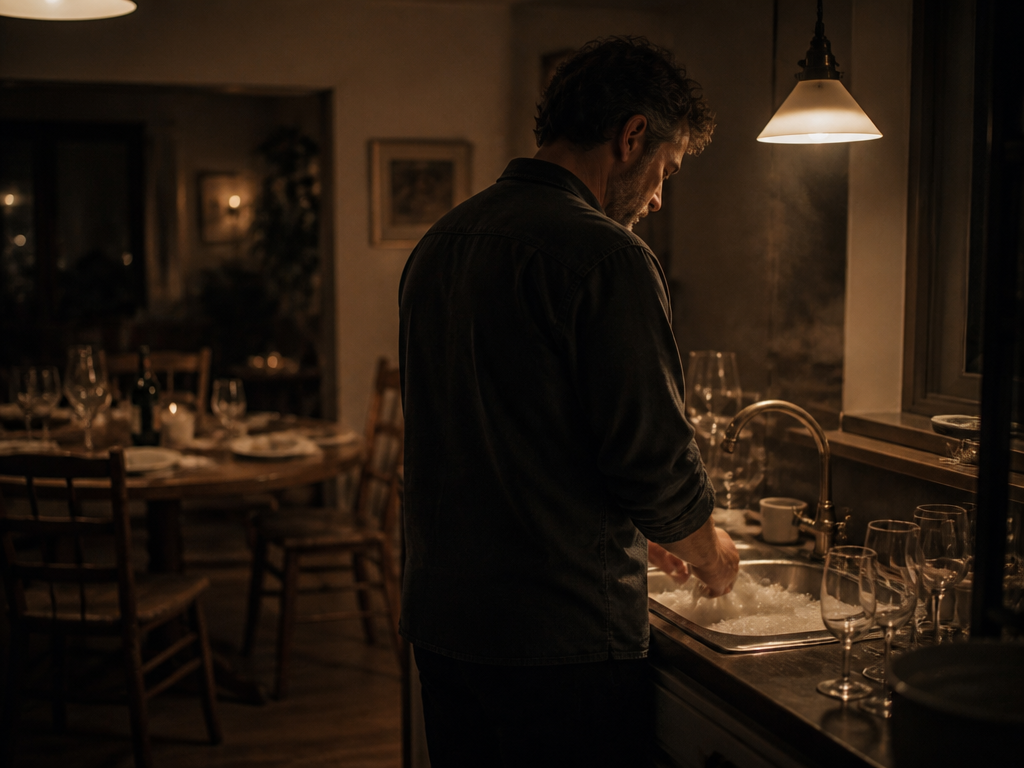
Driving home, my wife asleep against the window with her coat pulled over her, the heater ticking, I tried to name one true thing about anybody who had been at that table. Whether Ed was sick. What Ruth was afraid of at four in the morning. Anything. I had nine minutes on Lisbon and nothing else, and they'd had a lovely evening with a man who wasn't really in the house.
The first time I understood what those two mail carriers had between them, I was standing in a church basement holding a paper plate. My mother had been dead four days. People had been kind to me all afternoon in the way people are kind, and none of it reached anything. Then a woman I'd never met said she'd done my mother's hair for nineteen years.

"She never let me do the back," she said. "I'd get her wet and she'd — you know. Wouldn't hold still for the back."
That was all she had. That was the entire offering. And something came loose in my chest, because I knew precisely what she meant. I had spent my whole life watching my mother refuse to hold still for anything, and here was a stranger who'd stood behind her with a comb for nineteen years and knew it too. She wasn't consoling me. She was reporting in from the same country.
Which is not to say I got good at this. Ask my brother.
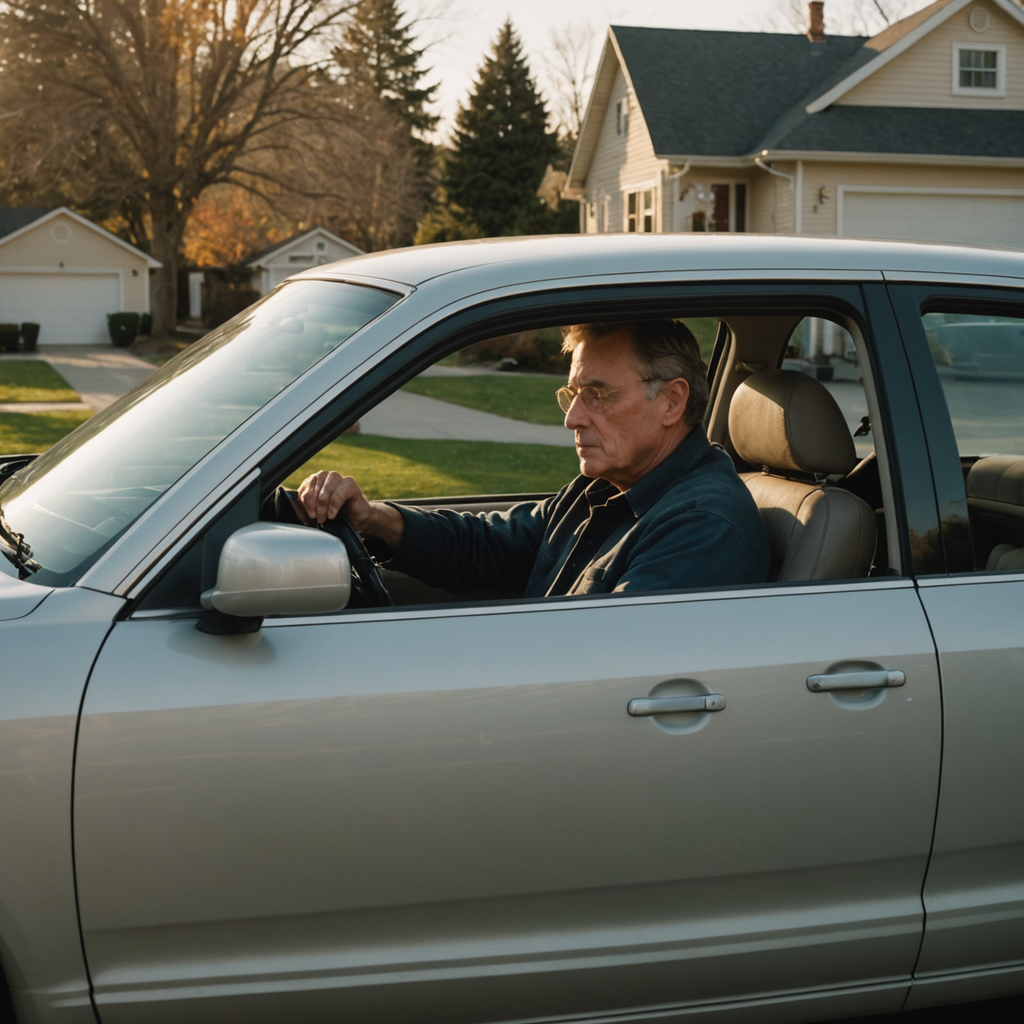
We were out on the dock at Kinney's, five or six years back, not catching a thing. He'd been quiet most of the morning and then he said, out of nowhere, that he'd been thinking about the night our father came home from the hospital and sat in the car in the driveway for almost an hour before he came inside.
And I said it was '79, not '80.
That's it. That's what I did with it. He said huh, and reeled in, and cast again a little short, and after that we talked about whether the boat trailer needed new bearings. There were gnats working the surface and the cooler smelled like old ice, and I understood right then that he had handed me something and I had checked it for accuracy. He hasn't brought our father up again since.
Now I'm retired, which mostly means I have time to notice what I used to walk past. Most mornings I take the dog out to the field behind the middle school at ten past six. There are five of us, more or less, and I know one name for certain. What we have in common is the cold and the fog sitting in the low corner by the gate and the particular way the light comes up gray behind the gym roof.
In February the woman with the thermos came without her collie. Nobody asked. Somebody said something about the ice on the far gate being bad again. She kept her hands up in her sleeves and stood out there the usual forty minutes and then went home. Three weeks later she came back with a young dog, ridiculous, all legs, and the man in the Bills coat said, "Well. Look at this," and that was the whole of the condolences and the whole of the congratulations.
I don't think what we're after from each other is to be understood, exactly. Understanding is a great deal to ask; half the time I can't manage it for myself. What we want is thinner than that, and more possible — some evidence that somebody else was out in the same weather. That the step really was rotten. That you didn't imagine the dog.
I paid and got up to go. Behind me the older one was writing something on the back of his receipt — a street, I think, or a name — and he slid it down the counter, and the younger man read it and put it in his shirt pocket, behind the pens.