There is a grocery list in my mother's handwriting that I cannot throw away. It's nothing — a torn half-sheet, the kind you'd find under a magnet on any refrigerator in Ohio. But down the right margin, in her tiny cramped print, she'd written initials. K for me, no peanuts. D for my father, no onions after the surgery. A small star next to the milk because my sister wouldn't drink it unless it was the kind in the glass bottle.
She carried all of us around in her head like that. Every preference, every flinch, every thing that might go wrong at a dinner table. And not one of us ever thanked her for it, because we never saw it. That was the whole point. The work that holds a family together is engineered to be invisible. You only notice it when it stops.
I've been thinking about that list a lot since I retired. About the things people kept and carried that nobody was supposed to find.
There was a casserole dish my mother lent to a neighbor when the woman's husband died. Pyrex, the kind with the little wire cradle. It came back three weeks later, washed, set on our porch with no note. My mother picked it up, turned it over, and said, "Well, she got it back to me." That was the whole sentence. I was maybe twelve, and I remember thinking there should have been more — a card, a knock on the door, something. But my mother had already moved on to the next thing she was carrying. She had taught herself not to wait for the thank-you, because the thank-you mostly didn't come, and a person can only stand at the window so many times before they stop looking out of it.
I inherited that posture without knowing I had.
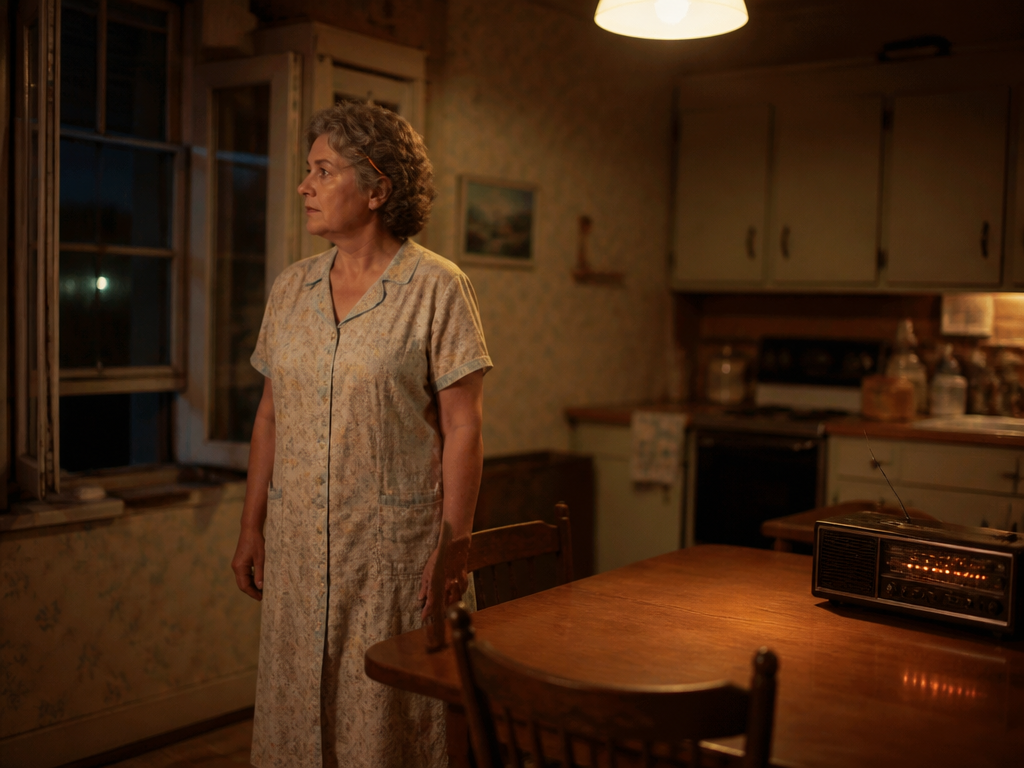
My father is harder to write about, because his care didn't look like care. It looked like a man at the head of the table who'd put a roof over us and considered the account settled. One night when I was fourteen I had a fever, and I came downstairs in the dark for water. He was at the kitchen table doing the bills, the lamp pulled low. He looked up. "You sick?" I nodded. He went back to the column of figures. "Drink something and go back to bed." That was the entire exchange. I understand now that he believed he was loving me — the numbers in front of him were a kind of love, the only dialect he had. But it landed as a closed door, and for a long time I assumed that providing was the same thing as being present. I built a marriage on that assumption before I knew it was an assumption.
My wife once tried to tell me. We were maybe eight years in. She said, "You're always doing things for us. You're just never here while you do them." I didn't understand. I pointed to everything I'd built — the addition on the house, the college fund, the cars that ran. She wasn't talking about any of that. She was talking about the man who fixed the gutter at seven in the morning so he wouldn't have to eat breakfast with anyone. I was so busy proving I was a good husband that I forgot to be one.

There was a coworker, Don, who said something at a retirement lunch years ago that has never left me. We were talking about somebody's wife, and Don, swirling his iced tea, said, "Must be nice. She doesn't work, she's got it made." The woman in question raised three kids, nursed her mother through a long dying, and kept Don's friend functional enough to show up at that office every morning for thirty years. But none of that registered as work, because work, in Don's accounting, was the thing that produced a paycheck and a title and a parking spot near the door. The other labor — the remembering, the soothing, the carrying — was simply the weather a family lived inside. Nobody pays the weather.
I laughed at his joke. I want to be honest about that. I laughed.
My daughter saved a note once. She showed it to me last year, of all things, slid it across her kitchen counter like evidence. It was something my wife had written to me decades back, taped to the inside of a cupboard. "Kevin — Sarah's recital moved to Thursday. She really wants you there. Please." I had no memory of the note. I almost certainly never read it, because I almost certainly missed the recital, because Thursday was a closing day at work and closing days were sacred. My daughter kept that piece of paper for thirty years. Not to punish me. She said she found it in a box and didn't have the heart to throw out her mother's handwriting. But I held it and felt the full weight of every quiet message I'd let slide past me unread — all the small flares people send up when they need you, the ones that don't look like emergencies until you add them all together.
The last thing I want to tell you about is the silence.
When I retired, the phone stopped ringing. Not slowly. It just stopped, the way a furnace clicks off, that sudden absence of a sound you forgot was running. For thirty-five years my worth had been delivered to me hourly — problems to solve, people who needed an answer only I had. Then one Tuesday I was standing in my own quiet kitchen at ten in the morning with a coffee going cold, and I realized I did not know who I was when no one needed anything from me. I had spent my whole life being useful so I wouldn't have to find out whether I was lovable. The two had gotten so tangled I couldn't pull them apart.
I started doing things nobody saw. I don't fully understand why. I'd shovel the widow's walk down the street before dawn and be gone before her lights came on. I fixed a fence at the church and told no one. At first it felt like a relapse — care performed for an empty room, the old habit wearing new clothes. But it was different, and it took me a long time to feel the difference. There was nobody to be impressed. Nobody keeping the account. I was, for the first time in my life, doing the carrying for its own sake, and discovering that it could be quiet without being lonely.
I'm not at peace with all of it. I still catch myself measuring my worth in things accomplished, still feel the old itch when a day passes and I haven't been useful to anybody. The wound doesn't close. It just gets quieter, and you learn its voice well enough to know when it's lying to you.
I kept the grocery list. It's in my desk drawer, under some old photographs. Last month my daughter was over and saw me looking at it, and she asked what it was. I told her it was just her grandmother's handwriting, the milk and the bread and all of us in the margins.
She was quiet a second. Then she said, "You do that, you know. You've got everybody's list in your head and you think nobody notices."