For a long time I thought a boundary was a sentence. Something you said clearly, in a calm voice, after rehearsing it in the shower. I imagined the people who could do this had a particular kind of spine, some inner architecture I'd been born without. It took me years to understand that my boundaries didn't live in sentences at all. They lived in objects. In small physical decisions I made without quite admitting what they meant. Here are some of them.
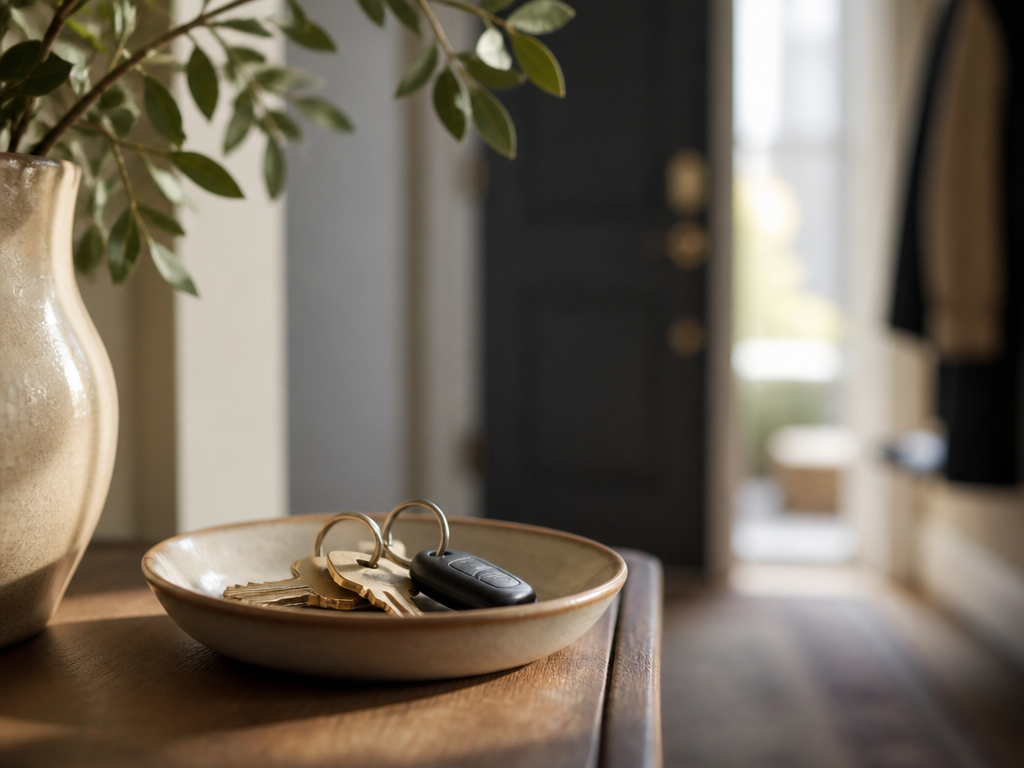
The first is a brass key on a faded ribbon, the kind you get from a hardware store that smells like cut metal. I gave it back to a man named Daniel on a Tuesday in October, on the steps outside his building, and I remember the way he turned it over in his palm like it was a foreign coin. We weren't even breaking up, not exactly. I had been letting him in and out of my apartment, my schedule, my weekends, for almost two years, and the key was just a symbol of how porous everything had become. "You sure?" he said, and I said yes before I knew it was true. Walking to the train I felt sick, the specific nausea of having done a thing I couldn't undo. I had expected to feel powerful. Instead I felt like I'd amputated something. That was the first lesson, the one nobody warns you about: a boundary, when you finally set one, often feels exactly like cruelty. Your body doesn't know the difference. It just registers that you took something away from someone who wanted it.
The second thing is a voicemail I kept on my phone for three years past its usefulness. My mother's voice, slightly clipped, asking why she hadn't heard from me, was everything alright, she only asks because she worries. I would play it sometimes when I felt like I was being a good daughter and wanted to undo that feeling. It was a small self-punishment. The message itself was harmless. What I couldn't delete was the thing underneath it, the way her worry was a hook I'd been swimming toward my whole life, mistaking the hook for love because it was the only shape love had ever taken. I finally erased it in a parking garage after a phone call where I told her I couldn't come home for the third weekend in a row. My thumb hovered. "Are you angry at me?" she had asked on that call, and I'd said no, which was true, but I'd also been unable to explain that not coming home wasn't anger. It was the closest thing to peace I'd found. Erasing the voicemail felt like betraying a version of myself who needed to be needed.
The third is a green sticky note that lived on the bottom corner of my work monitor for most of a year. It said, in my own handwriting: *You can want it and still say no.* A colleague named Priya had said something like it once, over lunch, when I was agonizing about whether to take on a project I had no time for. "You keep talking like wanting to help means you have to," she said, picking at a salad she clearly didn't like either. "Those are two different machines." I wrote it down badly, paraphrased it into something I could repeat to myself. The note curled at the edges over the months. I'd glance at it before answering emails, and slowly it changed how I typed. I stopped writing *of course* and *no problem at all.* I started leaving a beat of silence in conversations where I used to rush in to reassure people that their request hadn't cost me anything. The note didn't make me brave. It just reminded me, daily, that the discomfort I felt when I declined something was not evidence I'd done wrong. It was just the weather of being a person with limits.
The fourth is a folding chair, the metal kind, at a long table in my aunt's dining room. For most of my adult life I sat in whatever chair was left, gave up the good seat, took the corner where you have to twist sideways to reach your plate. One Thanksgiving I arrived early and sat down in the middle of the table, in a real chair, near the window. My cousin made a small joke about it. "Look who's expanding the empire," he said, grinning, and everyone laughed, and the laugh had a tiny burr in it, the sound a family makes when someone steps slightly out of their assigned role. I almost moved. I felt the old gravity, the magnetic pull toward the folding chair where I belonged, where I was easy to have around. I stayed where I was and ate my food and it tasted like nothing because my heart was pounding. Nobody remembers that dinner but me. That's the strange thing about the boundaries that matter most. They are almost always invisible to everyone except the person setting them, who is privately running a marathon while passing the green beans.
The fifth is a text I drafted and deleted maybe forty times. It was to a friend, someone I loved, who called me late at night to process the same breakup for the eighth month in a row. I had become her container, the place she emptied herself, and I'd told myself this was what good friends did. The text I kept trying to write said some version of *I can't be the only person you do this with.* Every draft sounded either too cold or too soft. I never sent it. Instead, one night when she called, I let it go to voicemail and sat on my kitchen floor with my back against the cabinet, listening to it ring, hating myself. When I called her back the next morning I said, "I think I've been a bad friend by always being available, because I don't think it actually helped you." It came out clumsy and half-wrong. She was quiet for a while. "Wow," she said finally. "Okay." We're still friends. It's different now, thinner in some ways and more honest in others. The unsent texts taught me something the sent ones couldn't: that I'd been keeping a careful ledger of all the ways I was sacrificing for her, a private resentment I called generosity. The boundary wasn't really for her. It was to stop me from becoming someone who kept score in the dark.
The sixth thing is a coffee cup, white with a chip on the rim, that I left on my father's porch and never went back for. We'd had a conversation that wasn't a fight, exactly, but had the temperature of one. He'd said something about my life choices in that offhand way that lands like a stone in still water, and for once I hadn't laughed it off or argued. I'd just stood up, put the cup down on the railing, and said I needed to head out. He looked surprised. "You just got here," he said, and I said I know, and I left. The cup is probably still there, or thrown away, or in his cabinet. I think about it more than I should. Leaving early wasn't a grand statement. It was the smallest possible act of self-respect, the kind that doesn't even register as a boundary to the other person, who only knows you cut the visit short and seemed a little off.
What I've come to believe, holding all these objects in my mind like stones in a pocket, is that boundaries aren't acts of strength. They're acts of grief. Every one of mine cost me a self I used to be — the endlessly available one, the easy one, the one who never made anyone feel the small sting of a no. I keep waiting to feel triumphant about it. I don't. I feel, mostly, like someone slowly moving out of a house they lived in too long, carrying things to the curb and surprising themselves at what they're willing to leave behind.
I told my sister some of this once, expecting her to understand, because she's better at all of it than I am. She listened to the whole thing, the key and the chair and the cup. Then she shrugged. "I don't know," she said. "I just never thought I owed everybody an explanation. You always thought you did."