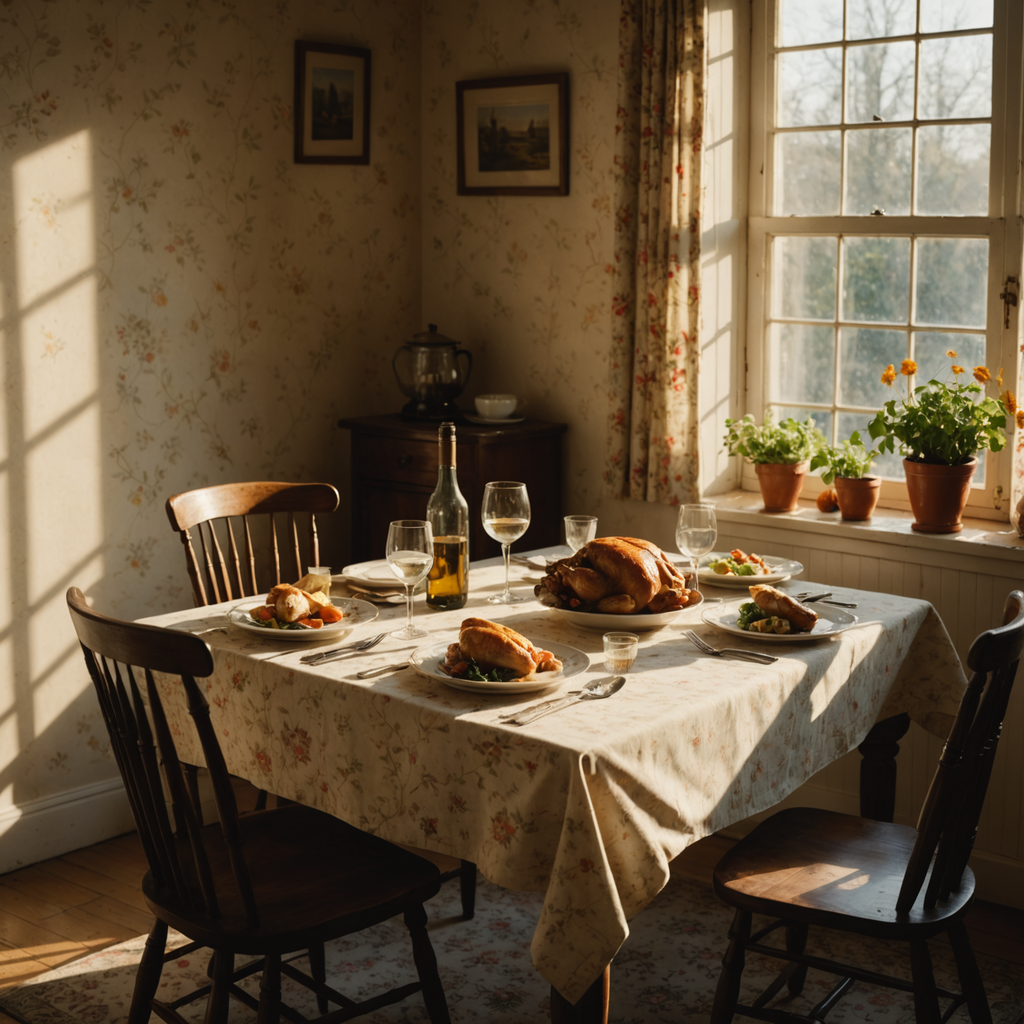
My brother was halfway through a story about his daughter's swim meet when I noticed the thing I wasn't going to say. His left hand kept finding the stem of his wine glass and turning it, a quarter turn, then back, while his wife stared at the centerpiece as though it had personally disappointed her. Something had happened in the car. Something was sitting between them like a third guest nobody had set a place for. I knew it the way you know weather is coming before the sky does anything about it.
Twenty years ago I would have said something. Maybe not at the table, but later, in the kitchen, drying dishes, I'd have leaned in and asked the question that pulls the loose thread. I used to think that was generosity. I used to think noticing carried an obligation, that if you saw the truth of someone you owed it to them to hand it back, like a wallet they'd dropped.
This time I refilled his glass and asked whether his daughter had taken the relay.
There's a version of this I'm not proud of, where the silence is just laziness dressed up as wisdom. I've worn that costume. But this wasn't that. I had simply done the arithmetic without meaning to, the way you do now, the way I didn't used to. My brother and I get maybe four dinners a year. I could spend one of them excavating whatever was wrong in the car, or I could spend it watching him light up about a fourteen-year-old's freestyle. The math had already decided before I knew I was doing math.
When I was younger, time felt like an open field. You could afford to be reckless with it. You could pick a fight at Thanksgiving because there would be a hundred more Thanksgivings to repair the damage. I remember one specifically, the year I was twenty-six, when I cornered my father by the garage about how he talked to my mother, the dismissive little hum he made when she spoke. I had rehearsed it. I delivered it. He set down the bag of charcoal he was carrying and looked at me with an expression I read, then, as guilt. I know now it was tiredness. He died eleven years later, and I cannot tell you what we fought about that day, only that I had been so sure the saying of it mattered more than the having of the afternoon.
Something happens to the field. It stops being a field and becomes a path, and then you can see where the path goes, and after that you start spending differently.
My friend Dana figured this out before I did. We were sitting on her back steps a few summers ago, and I was telling her about a colleague who clearly hated her job and was clearly never going to leave it, and how I kept wanting to point this out to her, to free her somehow. Dana let me finish. Then she scraped at a bit of dried paint on the step with her thumbnail and said, "What is it you actually want her to do." Not even a question, the way she said it. Flat. I started to answer and realized I didn't have one. I wanted to be the person who'd seen it. That was the whole of the want.

That landed harder than I let on. Because underneath a lot of my noticing-out-loud had been a hunger to be the one who noticed. Perception as a way of mattering. If I could read the room better than the room could read itself, I existed more.
What I didn't expect was how the hunger would quiet on its own, not through discipline but through subtraction. You start losing people. Not always to death — sometimes just to distance, to the slow drift, to the friend who moves three time zones away and becomes a birthday text. And the losing teaches you something about inventory. You begin to understand that you are not going to fix everyone, that you are not even going to be present for most of the lives you care about, and so the question quietly changes. It stops being "what do I see" and becomes "what is this hour for."
I watched a man learn this in fast-forward once. A colleague's father, dying of something in his pancreas, and I'd gone to the hospital to drop off documents and ended up staying. The old man had been famously difficult, the kind who corrected your grammar and your politics in the same breath. But that afternoon, with the light coming sideways through the blinds and a game show muttering on the wall-mounted TV, he didn't correct anything. His son said something slightly wrong about a road they used to take to the lake, got a turn out of order, and the old man just nodded. "That's the one," he said. It wasn't the one. I knew it wasn't because he'd told the story properly an hour earlier. He had decided the accuracy wasn't worth the hour. He had a finite number of sentences left and he was not going to spend one of them being right.
I think about that more than I think about almost anything.
There's a coffee shop near me where the barista always gets my order slightly wrong, foam when I asked for none, and for two years I let it go, and then one ordinary Tuesday I almost corrected her and didn't, and I stood there understanding that I will probably never correct her, that I have silently agreed to drink the wrong coffee for the rest of the time I live here, and that this is either a small grace or a small cowardice and I genuinely cannot tell which.
That's the thing nobody warns you about. The restraint feels like wisdom from the inside and might be fear wearing wisdom's coat. The man in the hospital — maybe he wasn't being gentle. Maybe he was just exhausted and the correction wasn't worth the breath, and I've spent years turning his exhaustion into a parable because I needed one.
My brother left that night around ten. He hugged me at the door longer than usual, and his wife had thawed by dessert, whatever it was passing the way weather passes. In the driveway he turned and said, "Good to be here. We don't do this enough," and I said something about Christmas, and we both knew we'd say the same thing at Christmas.
I stood in the cold watching the taillights and felt the old itch, the unsaid thing still unsaid. And I don't know, even now, whether holding my tongue was the most loving thing I did all evening or just the most convenient. How are you supposed to tell the difference, when both of them feel exactly like peace?